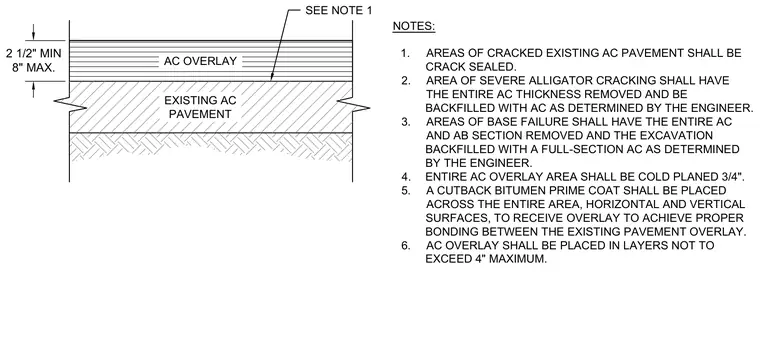
An asphalt concrete overlay is placed over existing asphalt pavement with a thickness ranging from a minimum of 2 1/2 inches to a maximum of 8 inches. The overlay area requires cold planing to a depth of 3/4 inch prior to placement. A cutback bitumen prime coat is applied across all horizontal and vertical surfaces to achieve proper bonding between the existing pavement and the new overlay. The asphalt concrete overlay is placed in layers not to exceed 4 inches maximum. Cracked existing pavement areas require crack sealing, while areas with severe alligator cracking require full asphalt thickness removal and backfilling as determined by the engineer. Base failure areas require the removal of both the asphalt concrete and aggregate base sections with full-section asphalt backfill.
EXISTING AC PAVEMENT AC OVERLAY 2 1/2" MIN 8" MAX. NOTES: 1. AREAS OF CRACKED EXISTING AC PAVEMENT SHALL BE CRACK SEALED. 2. AREA OF SEVERE ALLIGATOR CRACKING SHALL HAVE THE ENTIRE AC THICKNESS REMOVED AND BE BACKFILLED WITH AC AS DETERMINED BY THE ENGINEER. 3. AREAS OF BASE FAILURE SHALL HAVE THE ENTIRE AC AND AB SECTION REMOVED AND THE EXCAVATION BACKFILLED WITH A FULL-SECTION AC AS DETERMINED BY THE ENGINEER. 4. ENTIRE AC OVERLAY AREA SHALL BE COLD PLANED 3/4". 5. A CUTBACK BITUMEN PRIME COAT SHALL BE PLACED ACROSS THE ENTIRE AREA, HORIZONTAL AND VERTICAL SURFACES, TO RECEIVE OVERLAY TO ACHIEVE PROPER BONDING BETWEEN THE EXISTING PAVEMENT OVERLAY. 6. AC OVERLAY SHALL BE PLACED IN LAYERS NOT TO EXCEED 4" MAXIMUM. SEE NOTE 1
Members view this detail in full resolution, download the CAD files (SVG, PDF), and can adapt it in the built-in CAD editor — export DXF, DWG, or PDF.
Start membership